LoCo teams around the world

If you have been following the loco-contacts mail list you may have seen the recent hint that the coming LoCo Directory will be using the ownership of loco groups on Launchpad as a source of information about who is the LoCo contact for that group. This got me thinking.

How do different teams around the world organise themselves?

The assumption that the loco contact is always the same as the owner of the Launchpad group seems a bit simple. As teams evolve beyond a certain size, tasks get split, and the administration of the Launchpad group and the task of being Loco contact don’t necessarily go hand in hand.
So I’m curious – how do other teams get around delegating tasks and assignments?

In the rest of this blog post I shall try to give a short introduction to how we are currently doing things in the Danish team. I hope people from other LoCo teams will share their experience and ways of doing things as well. And of course pointers as to how we may organize the Danish team even better are very welcome!

Danish Team

Twice a month (except during holiday season) we have an IRC meeting. Everyone is welcome at the meeting, and this is where we discuss our future plans and events. If need be and we can’t come to a consensus on a topic, we have votes. One person, one vote. In essence, this is how the Danish team works currently.

ubuntu-dk-big

To take care of financial issues we have a board of trustees, including a treasurer. This makes handling money issues and making agreements with third parties a lot easier. Most people here (sponsors to make an example), will feel much safer donating money to an association, as opposed to some private person.

One a year (during spring) we have a general assembly, where we elect the board and the LoCo contact.

Of course this adds a bit of bureaucracy. We had to write some by-laws and we have to go through the entire hassle of having elections once a year. But it also secures that the board and the LoCo contact have a mandate from the community, and it makes it easy for the community to replace a LoCo contact or a board member, if they themselves can’t seem to realise that it’s time to step down.

That is how it works for us. Needs in other teams may be different, but I like the idea that once a year the position as LoCo contact is brought to debate and a vote, to make sure that (hopefully) the best person for the job is actually doing it.

So, how does everyone else do this?

Firefox 3.5

Mozilla Firefox 3.5 is here!

Watch Mike Beltzner (Director of Firefox) talk about what’s new:

And while we are watching videos, who doesn’t like a good car analogy, when explaining software?

mozilla firefox 3.5 from vineel reddy on Vimeo.

Get it here: http://getfirefox.com.
I haven’t seen an Ubuntu package yet, but I guess it won’t be long.

Fight Irans internet censorship

Much of the news about the situation in Iran concerning the 2009 election and following protests have been reported by regular people in Iran, not by news agencies.

As the government in Tehran tightens the grip on the internet access for the people of Iran, the natural question for people living outside Iran becomes:

Is there some way I can help the people of Iran get uncensored internet access?

(Inspired by Carsten here.)

If you know your way around a computer, and have access to a stable internet connection, there is.
One option is to set up Tor. Tor uses onion routing. Onion routing secures that you may know that I sent (or received) a message on the network or you may know the content of a message, but never both.

As discussed here the number of Tor users from Iran has increased quite a lot since around June 13, so it would seem like Tor is actually being used in Iran.

new_tor_clients_from_iranian_ip_space-small

Tor can be downloaded here, but does require a bit of configuration after install.

If you want to benefit from the anonymity provided by tor, you need to start sending your internet traffic through Tor, and in general familiarize your self with the pitfalls that may break your anonymity.

If you have a fairly decent internet connection you might want to consider becoming a relay from the Tor network to the outside. Information on that can be found here.

There are of course many other ways of fighting censorship (both in general, and in Iran in particular). Feel free to share info about other ways or projects in the comments below.

Warning! Running Tor may be illegal, depending on what laws apply to you. Also notice that while running a relay can help people, who suffer under censorship, communicate freely, you may as well be helping route data for people with less noble goals.

That was easy and painless…

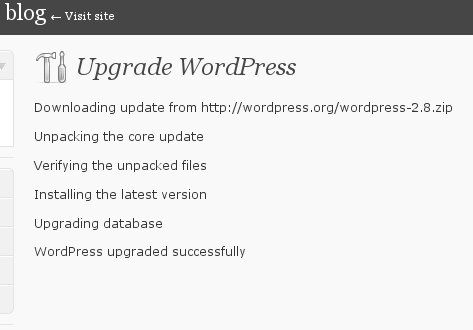
I just upgraded this blog to WordPress 2.8. As a reader, you properly won’t even notice, but as a publisher it seems I will now have smoother access to themes and widgets. See this video for all the goodness.

https://videopress.com/v/Pu3T4X8l

The upgrade was more easy than ever. I just clicked twice in the web interface, and it was done.

2.8

How easy is that?!? Great work from WordPress!

64-bit vs. i386 and Ubuntu vs. Kubuntu CDs

EDIT: Søren points out that the server CDs are in fact 64 bit. However I think the point made below is still valid for the desktop CDs.

There were a few comments to my latest blog post about the lack of 64-bit CDs in the LoCo CD box, and the reduced number of Kubuntu CDs compared to the number of Ubuntu CDs.

I don’t agree with this critique. As I see it, the CDs are for handing out and passing on to people who are completely new to the Linux / (K)Ubuntu game. These people don’t necessarily know what hardware is in their computer and a question like “Do you have at 64 bit processor?” won’t make sense to them. Worst case scenario the question will make the user feel stupid (not a good starting point for a great user experience with the new software) or the user will answer incorrectly, and will end up with a CD that doesn’t work with their hardware.
Sure, support for huge amounts of ram is nice, but I still think it is rare that the average user has and needs this (yet). And the user who does need it will be aware of the difficulties, and know to either ask the person who hands out the CD or do the research of how to get 64 bit support.

As to the number of Kubuntu vs. Ubuntu CDs I know this is a issue that a lot of people feel very strongly about. But the fact is that the average user who has never used anything else than Microsoft Windows doesn’t know the difference between Gnome and KDE (or the difference between Thunderbird and Evolution or the difference between Emacs and Vi…). The big strength of FOSS is the choices. But that is also one of the weaknesses. When you come along as a new user you are in no way qualified to make the choice between several different software packages, if you have no idea what the differences is. So you need someone else to make that choice for you. And if you find out you prefer another program than the one installed by default, the solution is often not further away than Synaptic or a link on the web: install kubuntu-desktop
(This link installs kde on a Ubuntu system. If I remember correctly it needs to fetch 100MB or more and will make KDE your default desktop environment. If you don’t know what that means, you don’t need to do it.)

That is why I think it is fine that Canonical has chosen to ship more plain Ubuntu CDs than Kubuntu and no 64-bit CDs at all. It limits the number of choices that the use can’t be expected to make anyway. And if you are well informed enough to make the choice you should also be expected to know what to do to get the system you want.

One CD, two CD, three CD…

The CDs for the Danish Ubuntu LoCo team arrived today. Less than one week after release. That’s quite fast if you ask me!

3-small

The CD box contains 250 regular Ubuntu 9.04 CDs, 75 Kubuntu CDs and 75 server CDs. All i386, there are no 64-bit CDs this time. If you have 64 bit hardware and want a 64 bit OS, hopefully you know how to download that your self.

EDIT: Søren points out that the server CDs are in fact 64 bit.

Ubuntu Live! in Aalborg

The Danish LoCo team and NJLUG threw quite a Ubuntu 9.04 release party yesterday, with talks, pizza, socializing and beer.

Our group photo, including a big cardboard Tux, is here:
ubuntu-dk_9_04-rp
(Photo by Martin Jensen.)

For a who is who see the Flickr or Facebook versions with tags.

Photo already sent along to Jono – remember to send your group photo from your release party too, as requested.

It was great fun seeing both familiar and new faces, with six months passed since last Ubuntu Live!. However I must admit I’m glad there isn’t a 6 hour train ride for me to get home after each release party. Next time will properly be in Odense or Århus, which is a bit closer than Aalborg.

Project Euler

For a long time I have wanted to improve my programming skills. Well, skills might be a overstatement. I have had two short introductory programming courses during my many years at uni, one C++ and one Java. But after the course is over I stop programming, since there are no more hand-ins, and as a result I quickly forget even the basics.

So now my hope is that if I spend one or two hours a week working with some problems (with a math twist to keep my focus) I will pick up the basics and get more familiar with Java (the programming language that I have chosen to start out with).

So I have started working the problems at Project Euler. I haven’t spend that much time working the problems yet, but I have solved the first two (using very brute force and non-elegant code), but it seems I have to do a bit of thinking for the third problem. Somehow working through all the integers from one to 600,851,475,143, check if they are a factor of 600,851,475,143 and then check if that factor is a prime is not the most optimal way to find the largest prime factor of 600,851,475,143. Back to the drawing board…

Of course I could ‘cheat’ and just do

$ factor 600851475143

in a shell, but that way I won’t learn much…

leonhard_euler

I first heard about Project Euler at the xkcd blag, but haven’t had the time to look into it before now.

If you know of other interesting problems useful for brushing up on a programming language, feel free to leave a comment.

And before I forget, a big thanks goes out to Søren, who has been very patient with my basic questions like “how do I check if one or the other condition is fulfilled in my if statement?”. I promise, I’ll pick up a book soon and stop bothering you with trivialities on chat!

MOTD with commercial links?

I know Planet Ubuntu might not be the best place to bring this up, but I feel that the bug report for bug number 268447 is not the right place for the more abstract discussion that seems to be needed. If there is already a discussion on a mail list somewhere that I have missed, please point me in the right direction.

The bug report in short points out that a link to the commercial service Landscape is added to the Message Of The Day by the landscape client. However, Landscape is not a free service.

There seems to be (at least) two sides to this bug. The first is who gets to modify the MOTD? As a client user logging in to a server, information about Landscape is completely irrelevant to me. Information about Landscape might be relevant to the server administrator, but not to every user of the system. So maybe the link should not go there? Imagine what would happen if every program go to modify the MOTD. The size of the MOTD could easily balloon to a point where the MOTD becomes useless.

The other issue is what kind of commercial services can be advertised in general.

How long until we see adds about new Firefox plugins or Crelm Toothpaste in the MOTD or somewhere else?